

Roman numerals are one of the oldest number systems in the world, originating in ancient Rome. Although modern mathematics primarily uses the Arabic numeral system, Roman numerals are still widely used in education, architecture, clocks, books, movies, and formal numbering systems. Understanding how numbers are written in Roman numerals helps build a strong foundation in number systems and mathematical history.
In this article, we will explore 110 in Roman numerals, understand how it is formed, learn the rules behind Roman numerals, view examples, look at real-world usage, study historical facts, and answer frequently asked questions.
What Is 110 in Roman Numerals?
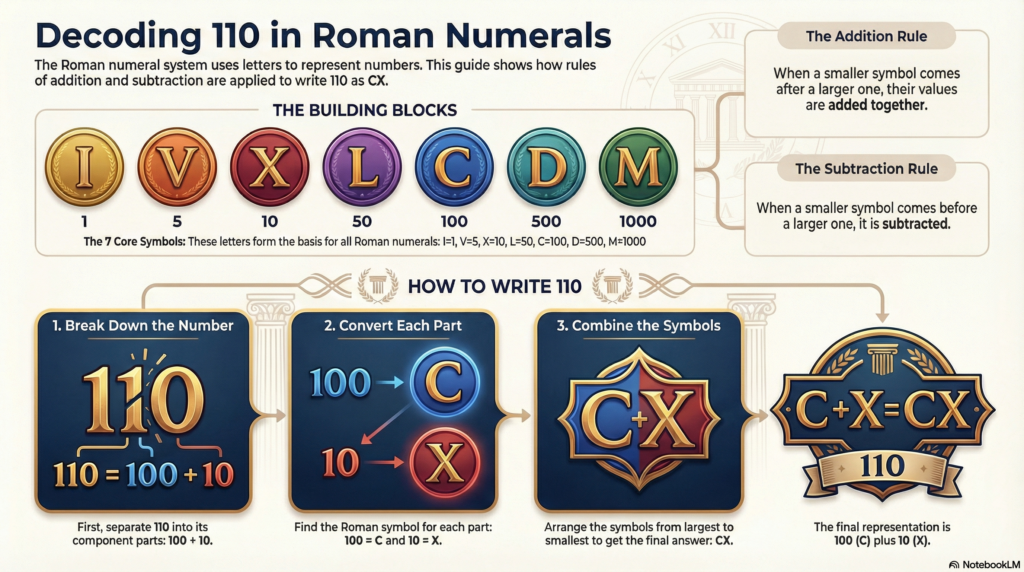
The number 110 in Roman numerals is written as CX.
This representation comes from breaking the number 110 into simpler parts:
- 100 = C
- 10 = X
When these values are added together:
110 = C + X = CX
So, the Roman numeral for 110 is CX.
Understanding the Roman Numeral System
Roman numerals use letters from the Latin alphabet to represent numbers. Unlike the modern number system, Roman numerals do not use place value or zero. Instead, they rely on a combination of symbols and rules.
Basic Roman Numeral Symbols
| Roman Symbol | Value |
|---|---|
| I | 1 |
| V | 5 |
| X | 10 |
| L | 50 |
| C | 100 |
| D | 500 |
| M | 1000 |
These seven symbols form the basis of all Roman numerals.
Rules Used to Write Roman Numerals
To correctly write Roman numerals, the following rules must be followed:
- Symbols are generally written from largest to smallest value, from left to right.
- When a smaller value comes after a larger value, the values are added.
- When a smaller value comes before a larger value, the smaller value is subtracted.
- The same symbol should not be repeated more than three times in a row.
- Roman numerals do not have a symbol for zero.
- Negative numbers cannot be represented.
Step-by-Step Conversion of 110 into Roman Numerals
Let’s convert 110 into Roman numerals step by step:
Step 1: Identify the largest Roman numeral less than or equal to 110
- The largest value is 100, represented by C
Step 2: Subtract 100 from 110
- 110 − 100 = 10
Step 3: Convert the remaining number
- 10 is written as X
Step 4: Combine the symbols
- C + X = CX
✅ Final Answer: 110 = CX
Roman Numerals Chart (100–120)
| Number | Roman Numeral |
|---|---|
| 100 | C |
| 101 | CI |
| 102 | CII |
| 103 | CIII |
| 104 | CIV |
| 105 | CV |
| 106 | CVI |
| 107 | CVII |
| 108 | CVIII |
| 109 | CIX |
| 110 | CX |
| 111 | CXI |
| 112 | CXII |
| 113 | CXIII |
| 114 | CXIV |
| 115 | CXV |
| 116 | CXVI |
| 117 | CXVII |
| 118 | CXVIII |
| 119 | CXIX |
| 120 | CXX |
Why Is 110 Written as CX and Not ICX?
Roman numeral rules do not allow arbitrary subtraction. Only specific subtraction pairs are valid:
- I before V or X
- X before L or C
- C before D or M
Since 10 (X) is added to 100 (C) and not subtracted, the correct form is CX, not ICX.
Real-World Usage of Roman Numerals
Roman numerals continue to be used today in many areas, including:
- Wall clocks and wristwatches
- Book chapters and volumes
- Movie sequels and franchises
- Sporting events and championships
- Monarchs and popes
- Legal documents and formal outlines
- Building cornerstones and inscriptions
Even though Roman numerals are not ideal for calculations, they remain popular for decorative and formal purposes.
Historical Significance of Roman Numerals
Roman numerals were developed over 2,000 years ago and were used throughout the Roman Empire. They were the standard numerical system in Europe for centuries before being replaced by Arabic numerals due to easier calculation methods.
Despite their limitations, Roman numerals played a major role in the development of mathematics, engineering, architecture, and trade during ancient times.
Interesting Facts and Statistics About Roman Numerals
- Roman numerals are over 2 millennia old
- They were used across Europe until around the 14th century
- There is no zero in Roman numerals
- Roman numerals typically represent numbers up to 3,999 using standard symbols
- There are only 7 basic symbols in the system
- Roman numerals are still taught in schools worldwide
- Over 60% of traditional analog clocks use Roman numerals for design aesthetics
- Major global events still use Roman numerals for numbering
Examples Related to 110 in Roman Numerals
Example 1: Convert 115 to Roman Numerals
115 = 100 + 10 + 5
= C + X + V
= CXV
Example 2: Convert 107 to Roman Numerals
107 = 100 + 5 + 1 + 1
= C + V + I + I
= CVII
Example 3: Convert 119 to Roman Numerals
119 = 100 + 10 + 9
= C + X + IX
= CXIX
Common Mistakes to Avoid
- Writing CXI for 110 (this equals 111)
- Using incorrect subtraction rules
- Repeating symbols more than three times
- Mixing Arabic numbers with Roman numerals
- Using zero or negative numbers
Practice Questions
- What is 110 in Roman numerals?
- Write 112 in Roman numerals
- Convert CX into an Arabic number
- What comes before CX in Roman numerals?
- Write the Roman numeral for 120
Frequently Asked Questions (FAQs)
1. What is 110 in Roman numerals?
110 in Roman numerals is written as CX.
2. How do you write 110 in Roman numerals?
Break 110 into 100 and 10, then write C for 100 and X for 10. Combine them to get CX.
3. What does CX mean in Roman numerals?
CX represents 110, where C equals 100 and X equals 10.
4. Is CX used for years as well?
Yes, CX can represent the year 110 in Roman numeral format.
5. Why is X added after C in CX?
Because 10 is smaller than 100 and comes after it, the values are added.
6. Can Roman numerals represent zero?
No, Roman numerals do not include a symbol for zero.
7. What is the Roman numeral for 100?
The Roman numeral for 100 is C.
8. What is the Roman numeral for 120?
120 is written as CXX.
9. How many symbols are used in Roman numerals?
There are seven main Roman numeral symbols.
10. Are Roman numerals still used today?
Yes, they are used in clocks, books, movies, events, and formal documents.
11. What is the highest number written using standard Roman numerals?
Using standard notation, Roman numerals typically go up to 3,999.
12. Is learning Roman numerals still important?
Yes, Roman numerals help develop number sense, historical understanding, and logical thinking.
Conclusion
Understanding 110 in Roman numerals is a simple yet important step in learning this ancient number system. The number 110 is written as CX, following basic Roman numeral rules of addition and symbol placement.
Roman numerals may be ancient, but they remain relevant in modern education and culture. Learning how numbers like 110 are written builds confidence in mathematical concepts and strengthens historical awareness.


