Top 20 Important Physics Formulas for 10th Class CBSE
Mechanics: Motion: Forces: Electricity: Light: Sound: Energy: Also Read:


Mechanics: Motion: Forces: Electricity: Light: Sound: Energy: Also Read:
Students often fear in physics due to its complex numerical

Trigonometric formulas for class 10 are given here for students.
In this article, we’ll explore the concepts of surface area

Coordinate geometry is a branch of math that combines the

Mensuration is the branch of mathematics that deals with the

The modulus of rigidity, also known as the shear modulus,
Calculus is a branch of Mathematics that deals with the
In the class 10 math formulas include formulas related to

Mathematics is an essential subject that plays an important role
Formulas are short rules that help you solve maths and science problems quickly and correctly. Knowing the right formula and when to use it saves time in school exams and competitive tests. This page gives a clear overview of the most important formulas from Class 6 to 12, how to learn them and how to avoid common mistakes.
Many students memorise formulas without understanding them and forget them under exam pressure. A better method is to learn what each symbol means, where the formula comes from and in which type of question it is used. Practise with examples and keep a formula sheet for quick revision. This builds both speed and confidence.
| Formula | Name / use |
|---|---|
| (a + b)² = a² + 2ab + b² | Square of a sum |
| (a − b)² = a² − 2ab + b² | Square of a difference |
| a² − b² = (a + b)(a − b) | Difference of squares |
| (a + b)³ = a³ + 3a²b + 3ab² + b³ | Cube of a sum |
| a³ + b³ = (a + b)(a² − ab + b²) | Sum of cubes |
| a³ − b³ = (a − b)(a² + ab + b²) | Difference of cubes |
| x = [−b ± √(b² − 4ac)] / 2a | Quadratic formula for ax² + bx + c = 0 |
Use these identities to expand, factorise and simplify expressions quickly. Always check the signs when applying them.
| Shape | Area | Perimeter / Circumference / Volume |
|---|---|---|
| Rectangle | l × b | 2(l + b) |
| Square | a² | 4a |
| Triangle | ½ × base × height | Sum of three sides |
| Circle | πr² | 2πr |
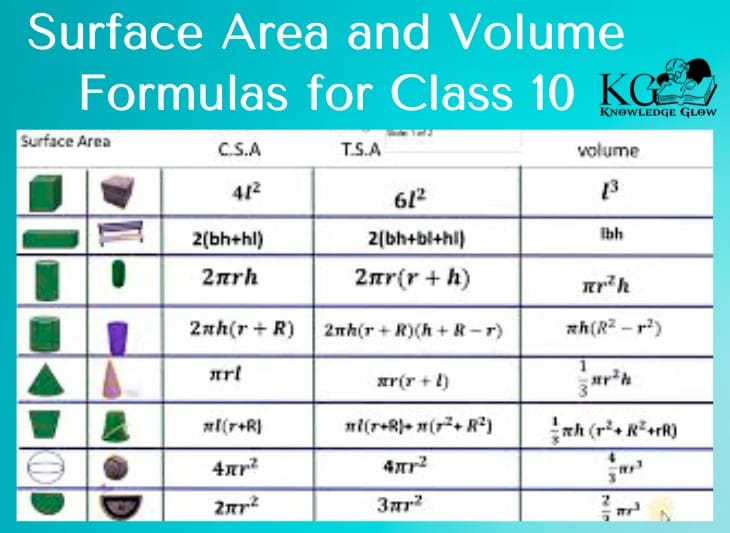
| Cuboid | Surface area = 2(lb + bh + hl) | Volume = l × b × h |
| Cube | Surface area = 6a² | Volume = a³ |
| Cylinder | Curved surface area = 2πrh | Volume = πr²h |
| Cone | Curved surface area = πrl | Volume = ⅓πr²h |
| Sphere | Surface area = 4πr² | Volume = ⁴⁄₃πr³ |
Remember to write units: cm² or m² for area and cm³ or m³ for volume.
| Formula | Use |
|---|---|
| sin²θ + cos²θ = 1 | Basic identity |
| 1 + tan²θ = sec²θ | Identity with tan and sec |
| 1 + cot²θ = cosec²θ | Identity with cot and cosec |
| tan θ = sin θ / cos θ | Ratio relation |
| sin 30° = ½, cos 60° = ½, tan 45° = 1 | Standard values |
Learn the table of values for 0°, 30°, 45°, 60° and 90°. These come in many board exam questions.
| Formula | Use |
|---|---|
| Distance = √[(x₂ − x₁)² + (y₂ − y₁)²] | Distance between two points |
| Midpoint = ((x₁ + x₂)/2, (y₁ + y₂)/2) | Midpoint of a line segment |
| Section formula (internal) = ((mx₂ + nx₁)/(m + n), (my₂ + ny₁)/(m + n)) | Point dividing a line in ratio m : n |
| Area of triangle = ½ |x₁(y₂ − y₃) + x₂(y₃ − y₁) + x₃(y₁ − y₂)| | Area from three vertices |
| Slope m = (y₂ − y₁)/(x₂ − x₁) | Slope of a line |
| Topic | Formula |
|---|---|
| nth term of AP | aₙ = a + (n − 1)d |
| Sum of n terms of AP | Sₙ = n/2 [2a + (n − 1)d] |
| Percentage | (Part / Whole) × 100 |
| Profit percentage | (Profit / Cost price) × 100 |
| Simple interest | SI = (P × R × T) / 100 |
| Compound interest amount | A = P (1 + R/100)ⁿ |
When using these formulas, write the given values first, check units and time periods, and then calculate carefully.
| Concept | Formula | Unit |
|---|---|---|
| Speed | Distance / Time | m/s |
| Acceleration | (v − u) / t | m/s² |
| Equations of motion | v = u + at, s = ut + ½at², v² = u² + 2as | — |
| Force | F = m × a | Newton (N) |
| Work | W = F × s | Joule (J) |
| Power | P = W / t | Watt (W) |
| Kinetic energy | ½mv² | Joule (J) |
| Potential energy | mgh | Joule (J) |
| Density | Mass / Volume | kg/m³ |
| Pressure | Force / Area | Pascal (Pa) |
| Ohm’s law | V = I × R | Volt (V) |
| Electric power | P = V × I | Watt (W) |
Always write the units in your answer and convert units if needed before substituting values. For more, explore our physics category.
| Topic | Formula or idea |
|---|---|
| Number of moles | Mass / Molar mass |
| Molarity | Moles of solute / Volume of solution in litres |
| Atomic number | Number of protons |
| Mass number | Protons + Neutrons |
| pH | −log [H⁺] |
| Balanced equation | Atoms on both sides must be equal |
In Chemistry, formulas are often paired with rules, such as valency and balancing equations. Learn symbols and valencies of common elements and practise writing chemical formulas for compounds. Visit our chemistry category for notes.
Find the area of a circle with radius 7 cm. Formula: Area = πr². Substitute: Area = 22/7 × 7 × 7 = 154 cm². The answer is 154 square centimetres.
Factorise x² − 25. Use a² − b² = (a + b)(a − b). Here a = x and b = 5. So x² − 25 = (x + 5)(x − 5).
A body of mass 5 kg has an acceleration of 3 m/s². Force = m × a = 5 × 3 = 15 N.
Find the simple interest on ₹2,000 at 5% per year for 3 years. SI = (P × R × T)/100 = (2000 × 5 × 3)/100 = ₹300.
Competitive exams such as JEE, NEET and government exams use many of these basic formulas along with more advanced ones. The key difference is speed and application. Practise mixed questions, learn short methods only after you know the standard method, and avoid depending on tricks without understanding.
| Mistake | How to fix it |
|---|---|
| Using the wrong formula | Identify the type of problem and write the matching formula first |
| Sign errors in algebra | Write each step and check signs carefully |
| Mixing units | Convert all values to the same unit before using the formula |
| Forgetting brackets | Use brackets when substituting negative or fractional values |
| Memorising without practice | Solve at least 5 questions on every formula you learn |
For calculators and step-by-step solutions, see our calculators and NCERT solutions pages.
| Quantity | Value (approx.) |
|---|---|
| π | 22/7 or 3.14 |
| Speed of light | 3 × 10⁸ m/s |
| Acceleration due to gravity (g) | 9.8 m/s² (often taken as 10 m/s² in problems) |
| Avogadro number | 6.022 × 10²³ per mole |
| √2, √3 | 1.414, 1.732 |
Use the value given in the question. If none is given, follow the textbook or exam instructions.
Encourage students to explain formulas in their own words and to apply them to real-life situations, such as calculating the area of a room or the cost of a loan. Make formula revision a short daily habit instead of a long weekend task. Praise understanding, not just correct answers. If a child struggles, go back to the concept and use simple examples before moving on.
Keep this page bookmarked and return to it before every test. Regular revision turns formulas from something to fear into tools you can use with confidence.
Browse our other guides by topic to plan your education step by step.
Understand the meaning of each formula, write it daily, use a formula sheet, and solve different questions with it.
Generally no. You must remember formulas for school and most competitive exams, unless the exam instructions say otherwise.
Algebraic identities, quadratic formula, arithmetic progression formulas, trigonometric identities, mensuration formulas, coordinate geometry and probability are important.
Write the equation in the form ax² + bx + c = 0, find a, b and c, and substitute them in x = [−b ± √(b² − 4ac)] / 2a.
Area = πr², where r is the radius. Use π = 22/7 or 3.14 as instructed.
Area measures the surface of a flat shape in square units, while volume measures the space inside a solid in cubic units.
It is a short list of formulas for a subject or chapter that you use for quick revision.
Start with speed, velocity, acceleration, equations of motion, force, work, power, energy, density and pressure.
Write the formula, list the given values, substitute carefully with units and check the final answer for reasonableness.
Use our maths, physics and chemistry categories and NCERT textbooks for detailed formulas and examples.
Try to understand the derivation so you remember it, then memorise it for speed. Both approaches help.
Calculators help with calculations, but you still need to know the formula and understand the problem.
Recent Comments